"Dangerous
and inefficient as many of these instruments were, they fulfilled a
purpose when all else had failed, the baby was dead, and the mother's
condition was critical. The time when any serious consideration
would be given to Caesarian section in the presence of a dead baby was
a long way off. Indeed Cesarean section was so dangerous that it
was rarely considered when the baby was still alive. In the
latter half of the nineteenth century considerable thought and effort
was devoted to other instruments for extraction." - Bryan Montague Hubbard, M.D. Ph D.
FRCOG. Emeritus Professor OB/ Gyn. University of Wales College of
Medicine. Author: The Obstetrician's Armamentarium. Norman Publishing,
2002......
|
|
Last
Resort Instruments
A midwife calls the man
midwife
only when
all her efforts have been futile. Often times the only reason for
calling the man midwife at childbirth was because the baby is already
dead and
needs to be extracted by performing
destructive surgical procedures to save the mother. It
seems to be a cruel procedure, however it was done as an act of
compassion to save the life of the mother. Typically the man
midwife was not called until 3 to 4 days or longer after the onset of
labor. Here are some of the gruesome
instruments
available to a man midwife at the time. |
|
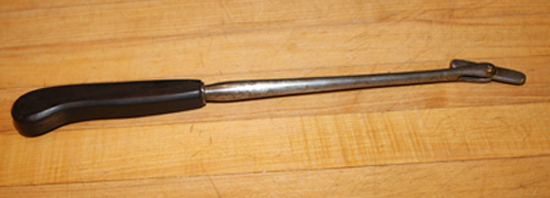
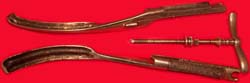
Tire-Tete
(Extractor) de
Mauriceau
Circa 1675
A
heavy weight device pierced into the decapitated or intact fetal head
for extraction. Unplated steel, 49 cm in length.
|
|
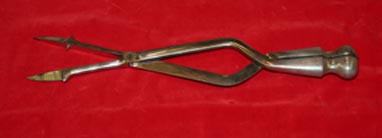
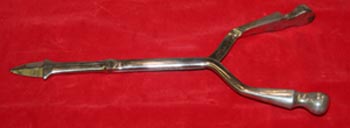
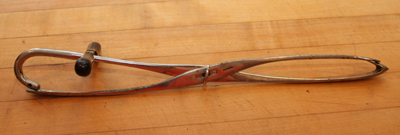
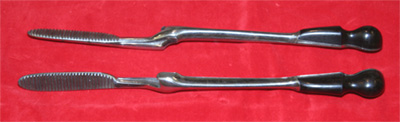
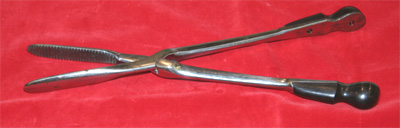
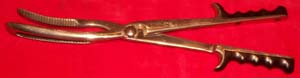
Tire-Tete De Levret
Circa 1740's
A huge tire-tete, used to extract
a beheaded baby. It has four blades to open out and circle the
cut off fetal head. Ebony handle with ivory base. 53 cm in length.
The pliable blades open up to more than 15
cm in diameter.
|
|
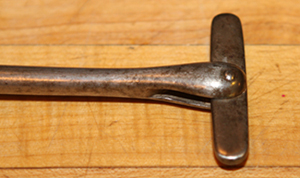
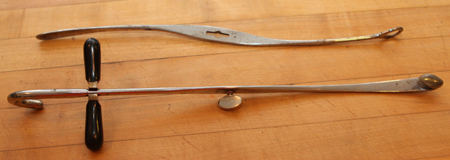
Levret's Bascule Extractor
Circa 1740's
A see saw tipped extractor placed into the perforated fetal skull for
extraction. Unplated steel, 36 cm in length.
|
|
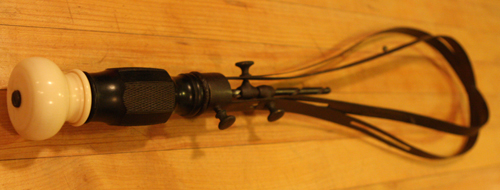
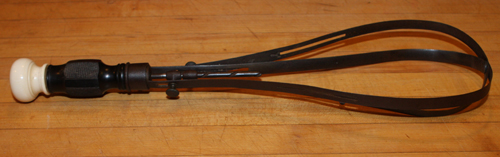
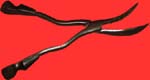
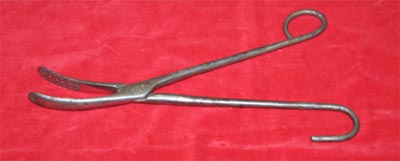
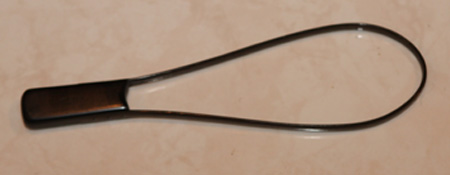
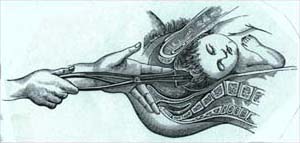
Fillet
Circa: Late 1800
The rigid fillet was used for
difficult deliveries in late 19th Century. It was used for
traction for intractable labors. The loop was made of whalebone
with the ends fixed in an ebony handle. The loop served as a
noose to grab the chin, forehead, groin, leg, or shoulder of the
baby. It was used as an alternative to the vectis or forceps. Its
use faded through time. 26 x 7.5 cm.
|
|
 |
Perforators
Frightful
instruments were used to
open the head
of the infant giving way for other destructive tools like the
cranioclast
or the crochet to extract the fetus as a whole or piecemeal. This
frightful
operation was done many times to save the life of the mother.
|
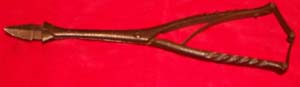
Various kinds of perforators:
|
|
Simpson's
Spring Loaded
Perforator
Unplated steel.
|
|
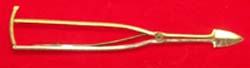
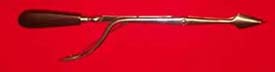
Naegele's
Perforator
Unplated steel
|
|
Blot's
Arrow Perforator
Plated steel with ebony handle.
|

|
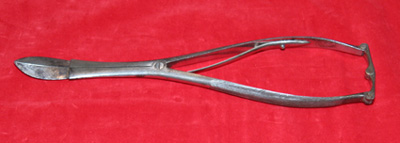
Smellie's
Perforator
Unplated steel.
|
|
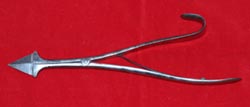
Naegele's
Perforator
Articulated
snapcatch handle lock perforator. Marked "Cizek & Hajsl."
Unplated steel.
|
|
Combination
Perforator and Hook
Unplated
steel. 28 1/2 cm (11 1/4") in length. Unmarked.
|
Simpson's Perforator
Unplated
steel. 35 cm (13 3/4") in length. Signed:
Maw London |
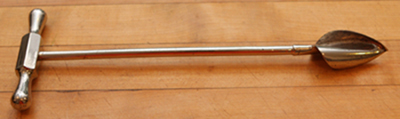
Thomas'
Perforator
Unplated steel, ebony
handle with scissor and cone shaped tip. Fig 3801, Tiemann
|
|
|
 |
Vicarelli
Perforator
Exceedingly rare destructive ob
instrument. It measures 27 cm. Plated steel.
|
Basilyst
A perforator or craniotomy
instrument with sharp
scissor like edge. The opening can be adjusted with a screw on
the
handle. It has a checkered ebony handle. Similar to illustration
on Bennion's Antique Medical Instruments, 1979, Chap 6, pg 128 Fig 18. |
A.R. Simpson Improved Basilyst
Circa 1884
The basilyst was
used for perforating the vault, and if required, it was advanced to
perforate the base of the skull. It has a double thread and split
to the point. Unplated steel with ebony handle. 41 cm (15
3/4") in length. Ref. Fig 19.36 p252. Hubbard's The
Obstetricians's Armamentarium.
|
|
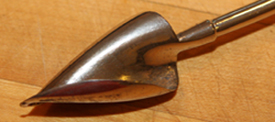
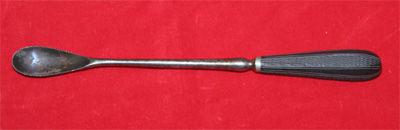
Thomas' Scoop
Circa 1870
It
was primarily used for the enucleation of myomas or the removal of
cancerous growths in the uterus. It was also documented being
used as a last resort for the piecemeal removal of an undelivered
fetus. Signed W.F. Ford.
|
|
|
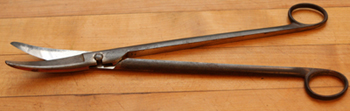
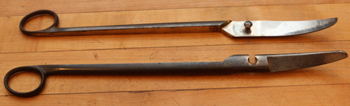
Dubois Embryotomy Decapitating Scissors
|
|
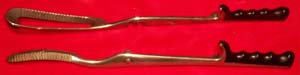
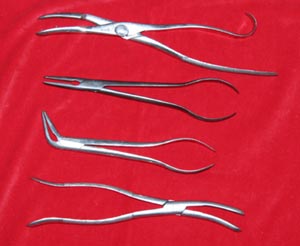
Craniotomy Forceps
From top to bottom: Thomas
Craniotomy forceps; Meig's, straight, angular, and curved
craniotomy forceps.
|
|
Trepine
Peforators
An instrument to bore a hole on the fetal skull as a
preliminary process in collapsing the
fetal head with a powerful destructive forceps
|
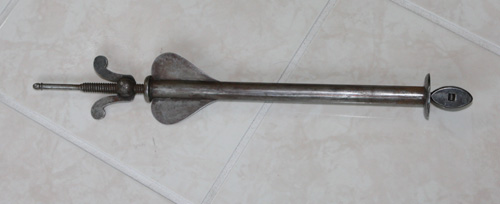
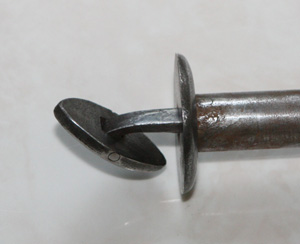
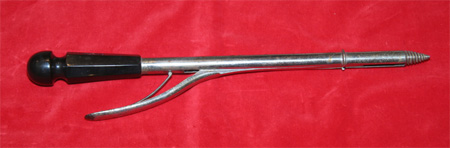
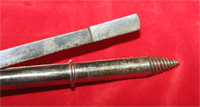
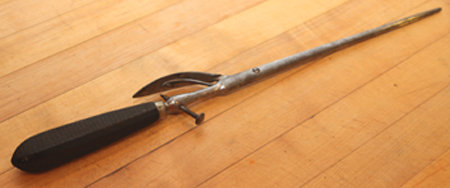
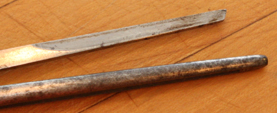
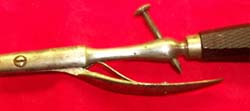
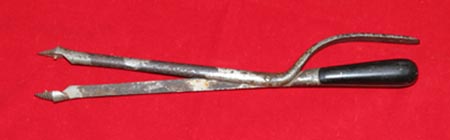
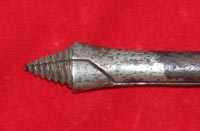
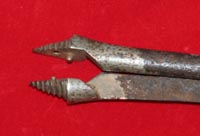
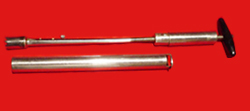
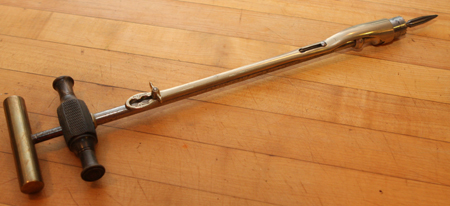
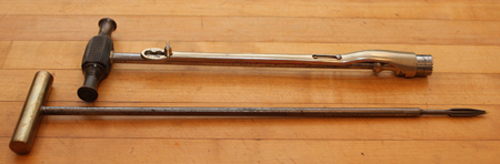
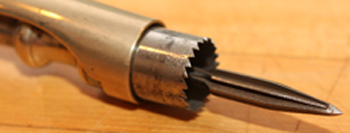
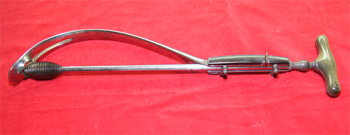
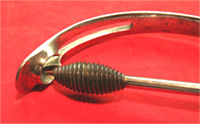
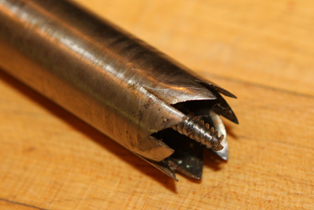
Trueheart's
Trephine
Perforator
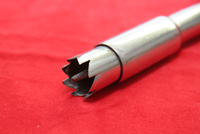
Assembled, separated, and the tip.
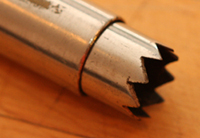
Assembled instrument on left. The
outer sheath
removed to show the componenents bottom left. The closed up view
of the trephine tip, bottom right. This destructive instrument
was
used to perforate the head of the fetus. Fig 3811, Tiemann.
Illustrated in Bryan Hibbard, M.D., the Obstetrician's Armamentatrium.
Noruman Publishing, 2000, page 224 fig 18.14 |
|
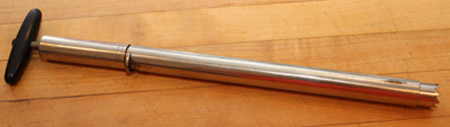
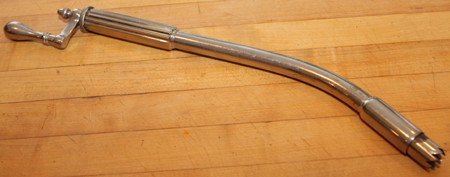
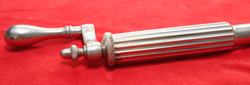
Braun's
Trephine Perforator
Circa late 1800s
This was used to bore hole on the fetal
skull as a prelimminary process in collapsing the skull with
a cranioclast. The instrument had a pelvic curve allowing the
crown to be placed over the head. Turning the handle while
applying pressure rotated the cutting edge of the crown, thereby
trephining the skull. The collapsed head would allow subsequent
extraction of the fetus. Plated steel, 44 cm long. |

|
|
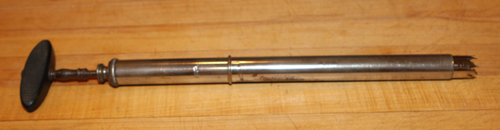
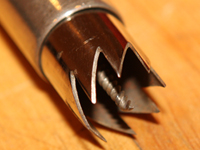
Trepine Perforator
with
metal handle
|
|
|
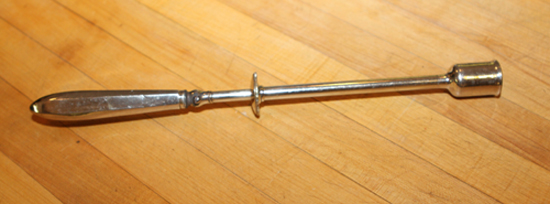
Leisnisch Kiewisch Trepine
Perforator
with Ebony handle.
|
|
|
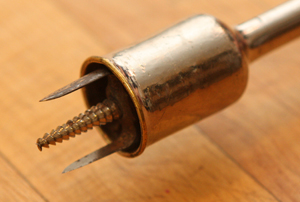
Luer Trephine Perforator
|
|
|
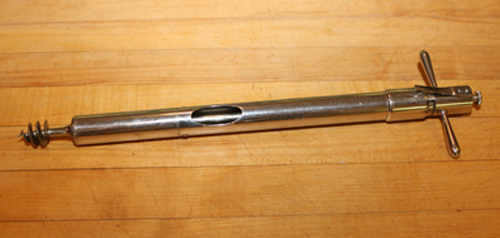
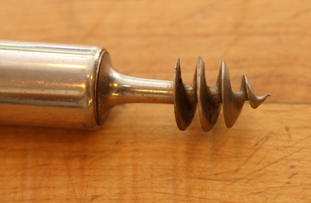
Corkscrew Perforator
|
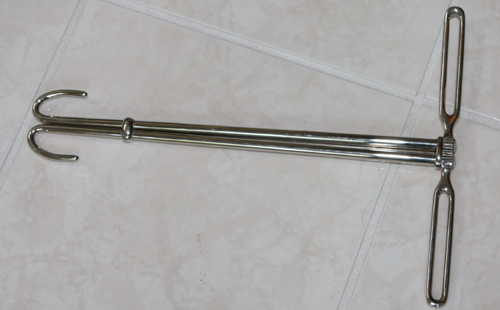
Zweifel's Trachelorhektor
Circa
1910
This
is a rare German destructive OB instrument invented by Zweifel.
The Trachelorhektor was illustrated in the Medizinisches Warenhaus
catalogue in Berlin published 1910. They call it "Two Armed Decapitation Hook".
|
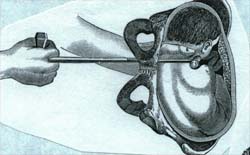
Hooks/Crochets
Blunt Hook- In
difficult
cases, extraction of the head or the trunk utilizes the blunt hook
inserted
around the neck or under the shoulder respectively. They were also used
to alter the position of the fetus as well as to hasten the delivery of
breech. The blunt hook were often used in combination with crochet.
Crochet-A
steel hook
with a sharp pointed end. After the initial breaking of the skull
with a perforator, the crochet was inserted into the cranium and grab
hold
the base of the skull for extraction.
Both crochet and blunt hook were
essential
for the practicing obstetrician in the late 1600 to late 1800.
The pointed end of the crochet
were used to
hook into the head, eye socket, shoulder bone, or any part accessible |
|
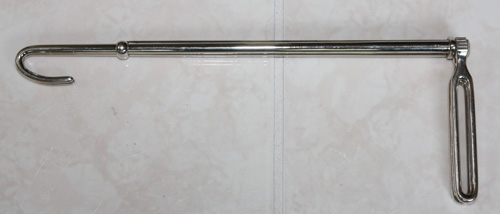
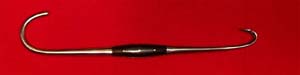
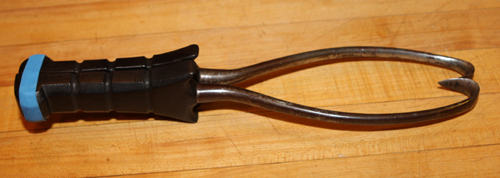
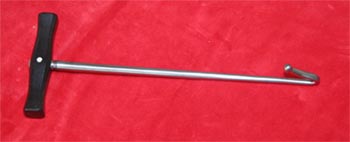
Blunt Hook
Unplated steel with ebony handle.
|
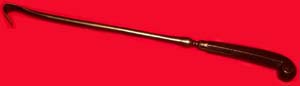
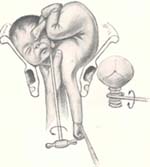
Hook &
Crochet
Unplated steel. Ebony
midshaft handle.
|
|
|
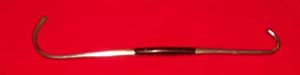
Braun's
Decollator Hook
|
 |
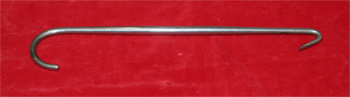
Double
Blunt Hooks
Large and small unplated steel
hooks with
ebony handle on mid-shaft.
|
|
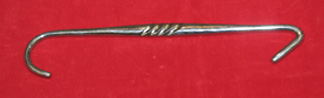
Hook
& Crochet
Unplated steel
|
|
|
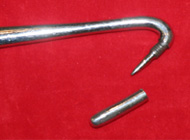
Hook
& Perforator
Hook with covered perforator.
|
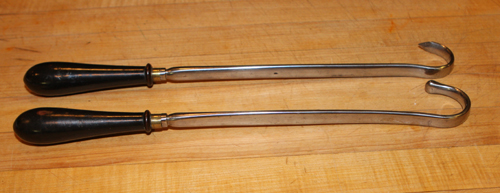
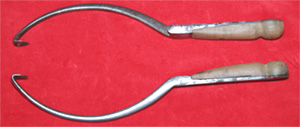
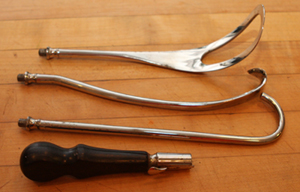
Paired Hooks: Black and brown wood handles, Crochet and Blunt hooks.
|

|
|
|
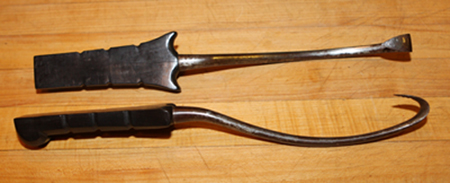
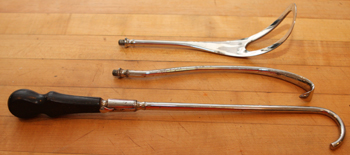
Sets of Hooks,
Crochet, and Vectis with detachable ebony handle.
|
|
4
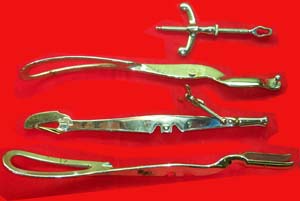
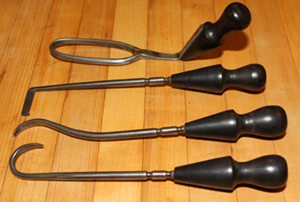
Sets of Destructive Obstetric Instruments:
From
top to bottom:
Fenestrated
vectis with 45 degree handle. Right angle decapitating hook,
Double-toothed crochet, and a sharp hook. Unplated steel with
ebony handles.
|
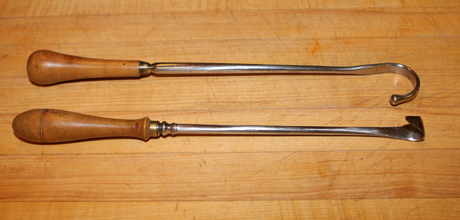
Wide-edged Crochet
Unplated steel with curved ebony
handle.
|
Point-edged
Crochet
Unplated steel with squared ebony
handle.
|
|
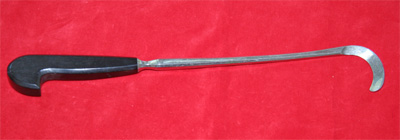
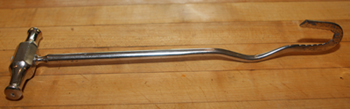
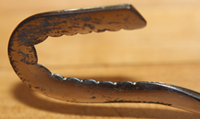
Ramsbothan's
Decapitator
A destructive Obstetrical hook with
ebony handle.
36 cm in length.
|
 |
|
Decapitation
Hook
According to Cuzzi-Tibone.
Plated steel. 33.5 cm in length |
|
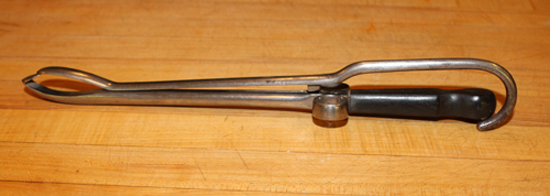
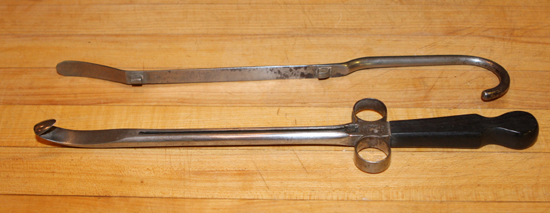
Guarded Blunt Hook & Crochet
Assembled and
separated. Upper handle and blade is reversible. Crochet were
used not only for extraction but also for piecemeal removal of fetal
parts like the abdomen and trunk of the fetus. Marked:
Tiemann. Fig 3811,
Tiemann.
|
|
 |
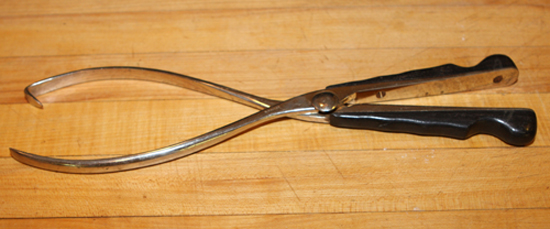
Bedford Guarded Crochet
|
|
Davis Guarded Crochet
Plated
steel blades with German lock and ebony handles.
|
Back
to Top
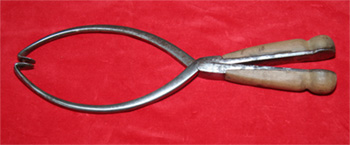
Smellie's
Double Crochet
Circa 1740s
They were applied to the outside
of the fetal
head as a single blade or using both blades as in the manner of an
obstetrical
forceps. Unplated steel with English lock and wooden handle. 30
cm/
12 inches in length. Illustrated on Bryan Hibbard, M.D. The
Obstetrician's
Armamentarium; Norman Publishing, 2000, page 228, fig 18.23
|
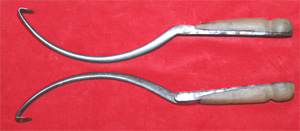
Levret's
Double Crochet
Circa. Early 1800's
A very rare destructive forceps
with notched ebony
handles. The blades could be used singly or in combination on the outer
side of the fetal head. Illustrated on Joseph B. De Lee, 1st
Edition,
1913, Principles and Practice of Obstetrics, Chapter LXXII, Mutilating
operations on the child. pg 1006 fig 893 d. Unplated steel,
32 cm in length. |
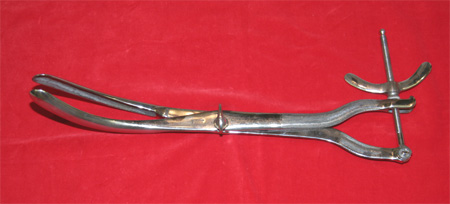
Braxton
Hick's Cephalotribe
Circa 1850s
A large and heavy dreadful tool
used for crushing
the bones of the fetal skull and face. All metal plated steel with
English
lock. 44 x 20 cm dimensions. |
|
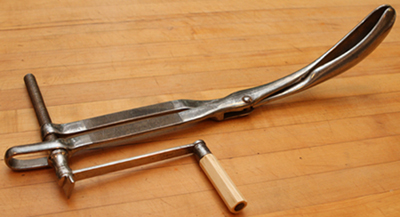
Simpson's
Cephalotribe
Circa 1850s
A humongous destructive obstetrical
instrument. 48 cm (19 inches) in length. Unplated steel.
|
|
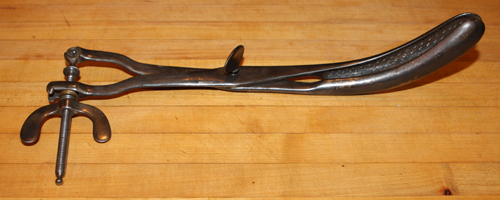
Baudelocque
Cephalotribe.
Circa 1820's
A
stunning 56 cm long and heavy cephalotribe. Similar instrument featured
in Hibbard pg 239.
The crank handle is made of ivory. It is marked "SIRHENDRY A
PARIS".
|
|
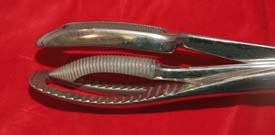
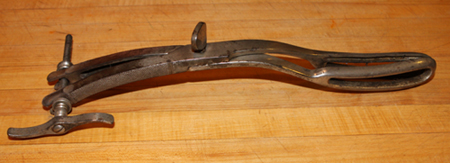
Blots's Cephalotribe
Powerful and heavy destructive
forceps. It is similar to the Simpson's cephalotribe except that the
grooved blades are spiked. Unplated steel.
|
|
Martin's Fenestrated Cephalotribe.
Large & heavy unplated steel to
crush the fetal skull.
|
Savigni
Cephalotribe
Circa:19th Century
Unplated
steel with ebony handle and English lock.
37 cm (14 1/2 ") in length.
|
|
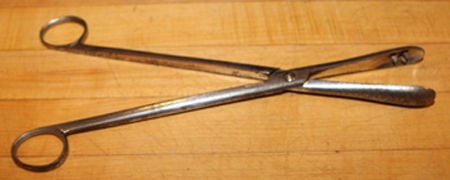
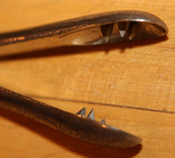
Cranioclast
A cranioclast is a powerful
forceps. The
blades are toothed, fenestrated or grooved. One of the blades
passes
within the skull of the fetus, while the other is introduced externally
to the cranium. Two blades articulate by means of a fixed screw
point.
Some cranioclasts have separate blades which are joined by a lock
similar
to an obstetrical forceps. |
|
|
Boer's Cranioclast
with spiked grooved blades.
|
|
|
Thomas's
Cranioclast
Unplated steel
|
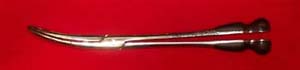 |
Mieg's
Craniotomy Forceps
Unplated steel with ebony handle
Fig. 3817, Tiemann.
|
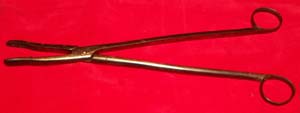 |
Scissor
Type Cranioclast
Unplated steel
|
|
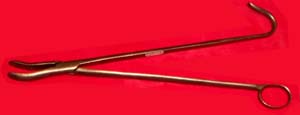
Cranioclast
Unplated steel. One handle,
hooked, the other
scissor type handle.
|
|
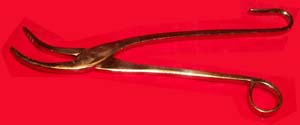
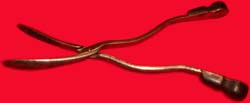
Godson's
Type Cranioclast
Nickel plated steel.
|
|
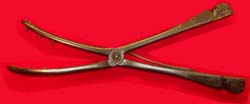
Conquet's
Cranioclast
Fixed screw point with ebony
handles.
Unplated steel.
|
|
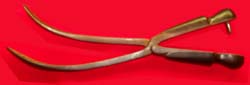
Holmes'
Cranioclast
Fixed screw point with ebony
handles.
Unplated steel.
|
|
|
Davis'
Cranioclast
with English
Lock
Circa 1840s
A cranioclast with two
separate blades articulated
by an English lock. One of the blades passes within the skull, and
being
furnished with teeth, perforates the bone, while the other
is introduced externally to the
skull, and
contains grooves into which the teeth of the first blade are
received.
It has a locating pin on the inside of the handles. When properly
fixed, the extremities of the handles are to be bound
firmly
by a tie, and steady traction applied to extract the dead fetus. |
Cranioclast
Circa
1860s
Hooked handle with toothed blade. 34
cm in length. Unplated steel.
|
|
Simpson's
Cranioclast
Conceived by Sir James Y. Simpson
to replace the
cephalotribe. A fenestrated blade positioned on the outer surface
of the head, while the smaller solid blade was inserted into the
previously
perforated skull. The crushed cranial vault was contained within
the scalp. It has a ribbed ebony handles with Siebold's lock which
allows
the instrument to be used in two positions. Marked S. Hawson
Thompson,
London. Circa 1870's. |
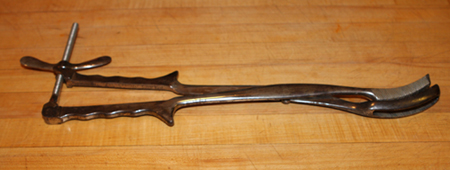
|
Kehrer's Cranioclast.
(A
Variation of the Braun Cranioclast)
|
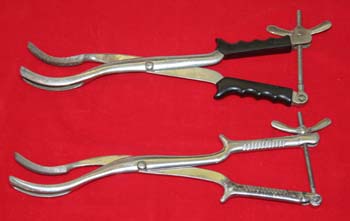
|
Braun's
Cranioclast
A
heavier version of the Simpson's cranioclast
|
L. J.
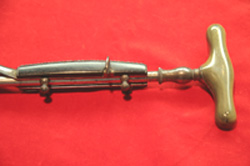
Hubert's Transforator
The olive-shaped end is screwed into the base
of the
skull, and the hinged blade is passed over the head. 47 x 10 cm
in dimension. Ref: Fig 19.34 p252. Hibbard's The
Obstetrician's Armamentarium.
|
|
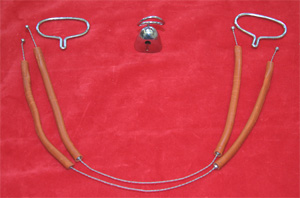
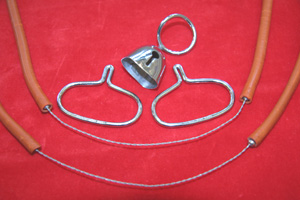
Blond- Heidler
Decapitation Saw
A very rare
destructive instrument
used to decapitate the fetus in diffiicult labor. The wire saw is
passed behind the fetal head using the thimble. The maternal
parts are protected from the saw by a rubber sheath. Handles are
connected to both ends of the saw. The blade is pulled back and
forth the fetal neck. Signed Lewis Bros London. |
|
Tarnier's
Basiotribe
Circa 1880's
A huge and heavy formidable
instrument of destruction.
A combination of a craniotomy forceps and a cranioclast. Used for
perforating and crushing the fetal head. All metal plated steel.
Fig 3813, Tiemann. 44 x 20 cm in dimensions
|
Auvard's Basiotribe
A
combinanation of cranioclast and cephalotribe. The center blade is for
perforation and screwing into the foramen magnum. The crushing
outer blades are then applied. There is a winged screw compressor
and a lock. Plated steel. 43 x 16 cm (17 x 7 ")
in dimension.
|
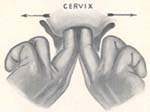
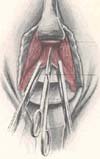
| If the cervix failed to dilate for a vaginal
delivery, or if the delivery seemed urgent, the accoucheurs in
the
past stretched, torn, or lacerated the cervix by force to accomplish
rapid
delivery. The procedure was called "accouchement force,"
delivery
by force. Several methods were used and many instruments were
deviced
to accomplish it. |
|
|
|
|
Manual Accouchement Force
Manual dilation of the
cervix. Few obstetricians continue to practice this
method
in modern times. |
Duhrssen's Incision
(1836)
Deep incisions
were made through several portions of the cervical canal to accomplish
rapid delivery of the infant. Often called the vaginal Cesarean
Section |
|
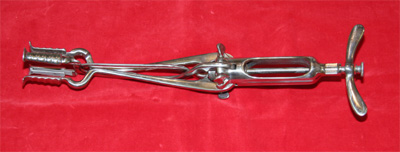 |
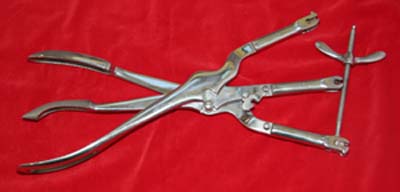
Bossi
Uterine Dilator
For
failure to progress, the cervix was
forcibly
dilated. A powerful screw at the handle would affect the handles to
separate
the cervix. This dilators were popular towards the end of the 19th
century,
but fell into disrepute because of severe lacerations it produced to
the
uterus. Signed:
Guiseppe Opezzo.
Ref :Bryan Hibbard, M.D.
The Obstetrician's Armamentarium. Norman Publishing, 2000.
Page 218, fig 17.9
|
 |
|
|
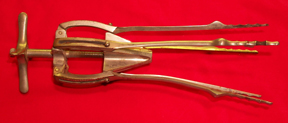
Preiss Cervical Dilator
Circa 1890s
Five bladed cervical
dilator, similar to Luigi
Bossi dilators. Plated steel, 27 cm in length, 9 cm widest
diameter of the
blade.
|
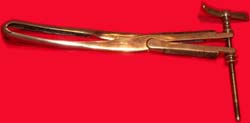
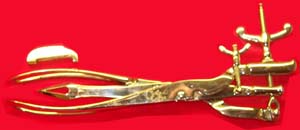
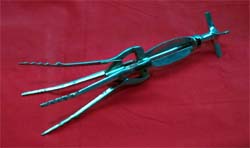
Weiss Cervical Dilator
Plated
brass with four awesome blades. A powerful screw at the handle produced
separation of the blades placed in the cervix. 35 cm long.
Circa 1890's.
|
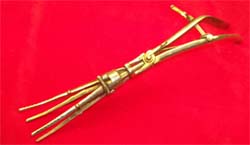
Four Bladed Dilator
Similar to Luigi Bossi insrument (1881).
Four branched dilator. This dilators was popular for a decade,
but
because of the cervical and uterine tears it produced fell into
disrepute.
39 cm in length. Plated brass. |
 |
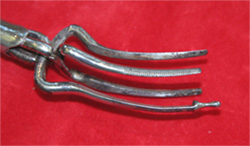 |
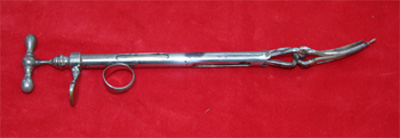
Finger
Grip Uterine Dilator
|
 |
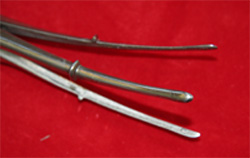 |
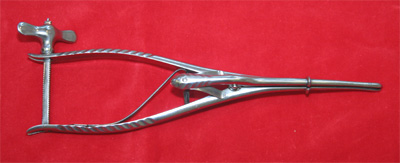
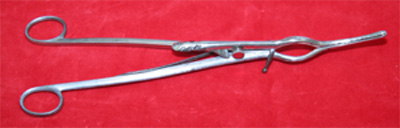
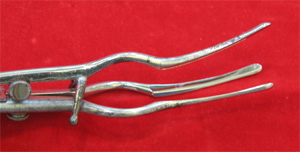
Sims'
Tri-bladed Uterine Dilator
Pressure applied to the tow bladed handle causes the
three blades of this uterine dilator to expand evenly.
|
 |
 |
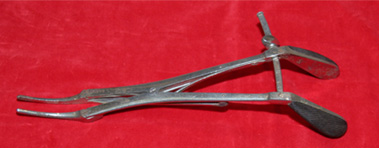
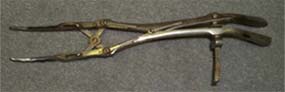
Scissor Handle
Tri-bladed Uterine Dilator
Scissor
handle grip with three bladed uterine dilator.
|
 |
|
Goodell's
Cervical Dilators
Circa 1870s
Ribbed ebony
handles on left. Made by Codman and Shurtleff of Bostorn.
Metal handles on right.
|
|
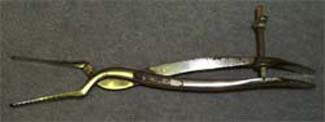
Wathen
Cervical Dilator
|
Back
to Top
All statements in
this web page
regarding date, age, and origin are statements of opinion. All
photos
and materials on this web page are protected by copyright laws.
Please
obtain direct permission from to
use any and all materials on this site, including photographs and
drawings. to
use any and all materials on this site, including photographs and
drawings.
|